
Coolant compatibility
Glycol blends, dielectric fluids and additives behave differently with elastomers. Confirm the actual coolant and concentration before selecting the tube.
Application · Liquid Cooling
A cooling loop is a chemical system, not just a hose. Coolant compatibility, permeation, bend radius and fitting torque decide whether the line lasts - and the protective layer around it decides whether the rest of the assembly survives a leak.
Application challenges
Glycol blends, dielectric fluids and additives behave differently with elastomers. Confirm the actual coolant and concentration before selecting the tube.
Thin walls permeate more and harden faster. Balance wall thickness against bend radius and pressure drop.
Tight bends kink the line and load the fitting. Define the minimum radius and fitting type before cut length is fixed.
A protective sleeve around the line keeps a small leak from reaching electronics, and adds abrasion protection at pass-throughs.
Recommended materials
Chemically inert, low friction bore, -200 to 260 °C, for aggressive media and clean loops.
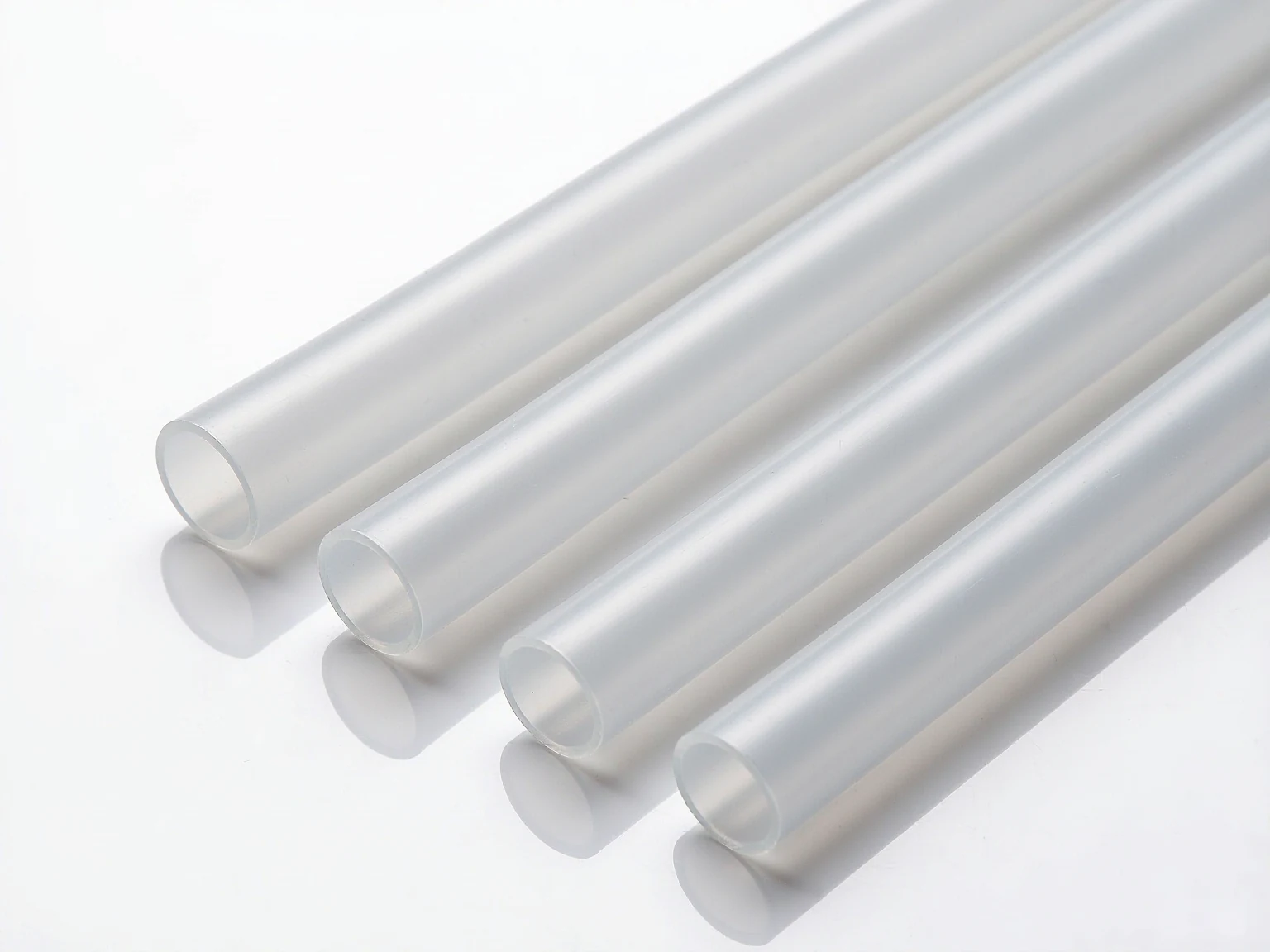
View detailsFlexible, high-purity tubing for coolant and steam lines with custom ID / OD.
View detailsOuter routing protection with high crush resistance at chassis and cabinet pass-throughs.
View detailsWrap-around abrasion and leak-containment layer for installed lines.
View detailsChemical-resistant protection at fittings and sensor transitions.
View detailsSelection checklist
Coolant: Chemistry, concentration, additives and operating temperature
Pressure: Working and burst pressure, pressure drop budget
Dimensions: ID, OD, wall thickness and cut length
Routing: Minimum bend radius, fittings, vibration
Cleanliness: Particle, extractable or cleanliness class requirement
Documents: RoHS / REACH, material declaration, USP Class VI on request
Catalogue values describe the product direction we can supply. Confirm final drawing, grade, tolerance and test method before mass production.
FAQ
PTFE is chemically inert and has the widest media tolerance; silicone is more flexible and easier to route. For glycol loops with tight bends, silicone often wins on assembly; for aggressive or high-purity media, PTFE is safer.
Yes. ID, OD, wall thickness, colour and length can be specified; tooling and minimum quantity depend on the size.
RoHS and REACH declarations are available by grade. Food or medical grades with USP Class VI documentation can be quoted on request.
Permeation scales with wall thickness and temperature. Send the coolant and the acceptable loss rate and we will propose wall thickness and an outer barrier if needed.
Quote and samples
Coolant chemistry, working temperature and pressure, ID / OD, bend radius and fitting type are enough for a tube and protection proposal.