
Automotive harness routing
Underbody, door, instrument panel and pass-through sections: abrasion, temperature and assembly cycle time all have to be satisfied at once.
WCW harness protection
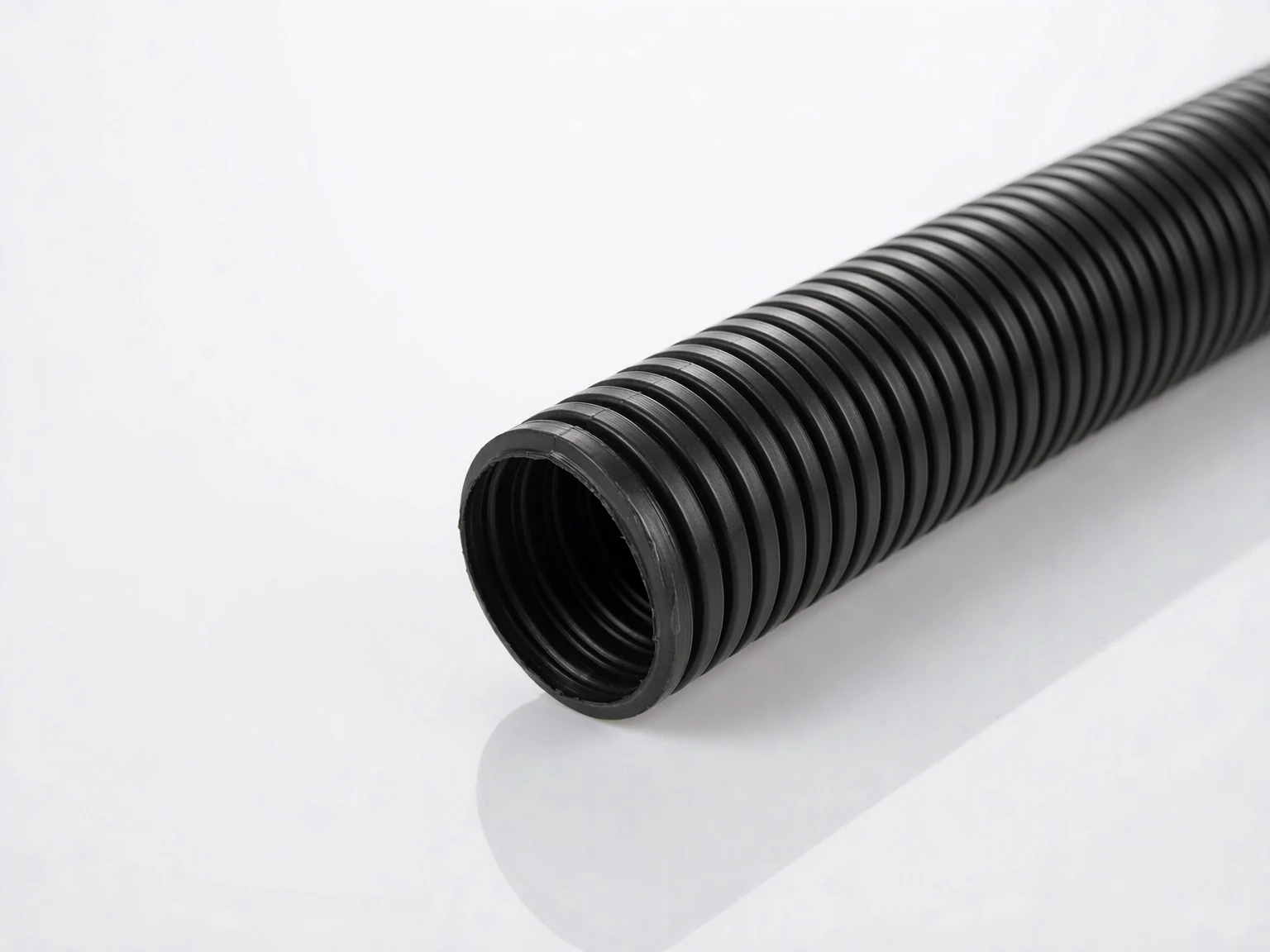
Corrugated tube trades a smooth wall for flexibility and crush resistance, which makes it the practical choice for shaped routing and pass-through protection in tight spaces. Selection comes down to matching inner diameter to bundle size, checking material temperature, deciding whether the tube must be slit, and confirming flame and abrasion class.
Applications
Underbody, door, instrument panel and pass-through sections: abrasion, temperature and assembly cycle time all have to be satisfied at once.
Routing and edge protection inside enclosures, where flame class, slit convenience and bend radius matter most.
Moving cable runs on robots, modules and actuators, where repeated flexing and crush loads dominate the requirement.
Long runs under vibration, oil mist and temperature cycling; flame and temperature class should follow the vehicle or system standard.
Specifications
Material: PP / PA / PVC, chosen by temperature, flame class and cost target
Continuous temperature: PP approx. -20 to 100 °C, PA approx. -40 to 120 °C; confirm by grade and duty
Construction: Closed and slit (open) types; slit tube allows installation without de-pinning terminals
Flame class: V-0 grades available; confirm against the target market standard
Inner diameter: Commonly 4.5 to 32 mm; other sizes evaluated per project
Supply form: Coil, cut to drawing length on request
Catalogue values describe the product direction we can supply. Confirm final drawing, grade, tolerance and test method before mass production.
Material declaration
RoHS and REACH declarations are available for the selected material and project scope, together with flame test documents. If the target market requires UL or third-party reports, state the standard and test items before ordering.
Datasheet and samples
Send the maximum bundle diameter, operating temperature, whether the tube must be slit, flame class, bend radius, cut length and annual volume, plus the end industry and required documents. That is enough for us to confirm a sample plan.
FAQ
Choose slit tube when the harness is already assembled or terminals are crimped and cannot be passed through. For new builds where tube is fitted before termination, closed tube holds position better and gives fuller coverage.
Leave 10 to 20 percent clearance over the maximum bundle OD, then check bend radius and branch positions. An overfilled tube loses flexibility and increases assembly force.
PP is roughly -20 to 100 °C and PA roughly -40 to 120 °C. The usable range depends on grade, continuous versus peak duty, and proximity to heat sources.
Yes. Cut length follows your drawing, colour and packaging can be specified, and slit width can be adjusted to the installation method.
Related products
Expandable, abrasion-resistant outer protection for branching harness bundles.
View detailsSealing and strain relief at terminals, splices and connector transitions.
View detailsFlexible silicone and chemical-resistant PTFE tubing for fluid lines.
View detailsQuote and samples
Maximum bundle diameter, operating temperature, slit requirement, flame class, bend radius, cut length and annual volume are enough for a material proposal.