Application Solution · EV Powertrain Insulation

How to Insulate and Protect EV Battery Pack Connectors

Battery pack insulation is not about choosing one high-voltage material. Each of six protection points needs its own material family, dimensions and validation. Temperature, coolant and vibration are underestimated far more often than voltage.

Six protection pointsThree material familiesFour validation testsConfirmed per project
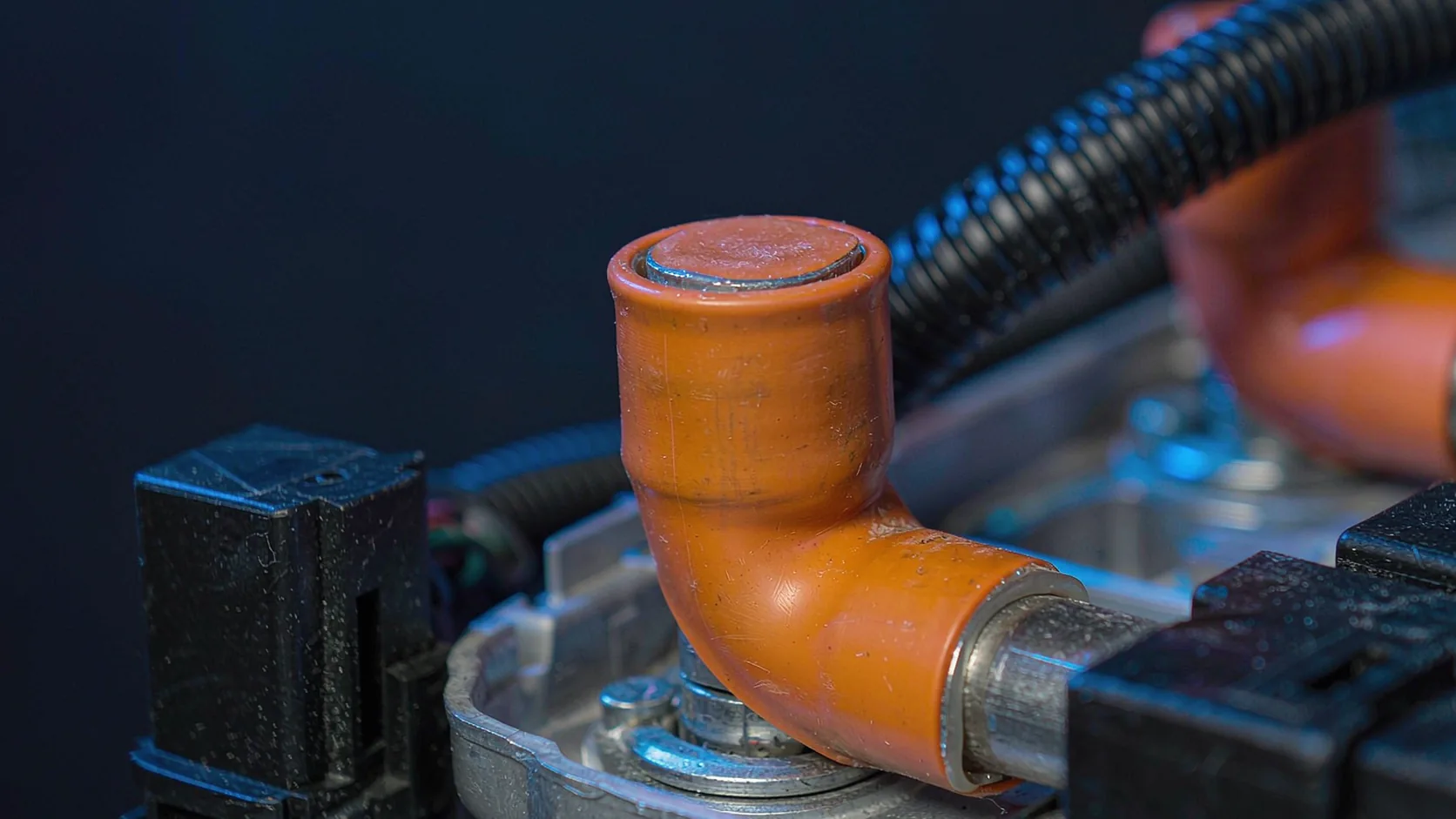
Insulation and sealing at the tail of a high-voltage connector in an EV battery pack
Insulation protection at the connector tail

Insulation inside a battery pack differs from conventional electrical equipment in one fundamental way: it faces high voltage, high temperature, vibration and coolant all at once, and a failure can escalate to thermal runaway.

This guide skips standards text and focuses on the engineering: which materials to use, and where designs go wrong.

Protection point checklist

1. Start here: which parts of a battery pack need insulation

A typical pack concentrates insulation needs in six areas:

PartMain riskProtection focus
Cell terminals / busbarsExposed HV, metal-dust bridgingInsulation wrap + flame retardancy
Module interconnect tabsAssembly abrasion, vibration wearWear resistance + flexibility
HV connector tailCable bending, seal failureStep sealing + strain relief
HV harness trunkFriction against metal housingWear + temperature resistance
Sensing harness (LV)Thin wires easily damagedSmall-ID fiberglass sleeving
Cooling line pass-throughCoolant ingress, condensationHydrolysis resistance + sealing

Each area needs a different material. Using one material everywhere is a common design mistake.

Material roles

2. Material selection: three workhorse materials

Fiberglass sleeving (silicone resin / silicone rubber coated)

High temperature resistance, mechanical strength and flame retardancy suit cell terminals, busbar wrapping and areas near heat sources. An ID range of 0.3–100 mm lets it serve both thin sensing wires and busbars.

Heat shrink tubing (adhesive-lined dual wall)

Shrinks to form a seal, ideal for connector tails and harness branch joints. The adhesive fills gaps and blocks axial condensation ingress — in packs with frequent thermal cycling this matters more than insulation alone. Use 3:1 or 4:1 at connector tails to cover steps.

Braided sleeving (PET / self-wrapping)

Soft, abrasion-resistant and openable, suited to external protection of harness trunks and later servicing. Self-wrapping types can be fitted without disconnecting wires — useful in aftersales and retrofit work.

Common mistakes

3. Four mistakes to avoid

Mistake 1: selecting insulation by voltage only

800 V platforms draw attention to dielectric design, but in real failure cases thermal ageing is more common than voltage breakdown. Local pack temperatures can stay above 100 °C for long periods, so select for continuous temperature, not ambient average.

Mistake 2: ignoring coolant attack

Coolant in liquid-cooled packs (usually a glycol-water mix) can swell or harden certain materials over time. Protection on harnesses crossing cooling zones needs coolant immersion testing, not just a temperature rating.

Mistake 3: squeezing the adhesive layer too thin

Stretching the tube during assembly or choosing an oversized ID leaves too little adhesive to fill the gap, so the seal fails. Recovered ID should be slightly smaller than the substrate OD to keep the adhesive under compression.

Mistake 4: verifying flame retardancy only at pack level

Material-level ratings (UL 94 V-0, VW-1) and a full-pack fire test are different things. Confirm the rating during material selection rather than discovering non-compliance at pack validation.

Selection workflow

4. A practical selection workflow

Step 1 · List the protection points

For each of the six areas above, record temperature, voltage, media and bending frequency.

Step 2 · Choose the material family

Fiberglass sleeving for hot zones, adhesive-lined dual-wall tubing where sealing is needed, braided sleeving for wear resistance and serviceability.

Step 3 · Set dimensions

Choose ID at 1.1–1.3× the harness OD; use 3:1 or 4:1 for step transitions.

Step 4 · Validate

Cover at least dielectric withstand, thermal cycling, coolant immersion and vibration/abrasion.

Step 5 · Confirm certifications and documentation

Check UL file numbers, RoHS/REACH and IMDS data; vehicle programmes also require IATF 16949 system support.

Products and capability

5. Wachangwei products for battery pack applications

Founded in 2002, Shenzhen Wahchangwei Industrial Co., Ltd. was among the first Chinese insulation sleeving manufacturers to obtain UL/CUL certification.

CapabilityDetails
Fiberglass sleevingID 0.3–100 mm, temperature up to 600 °C (per model datasheet); certain types tested to 50 kV dielectric withstand; used for terminal/busbar wrapping and sensing wire protection
Heat shrink tubing2:1 / 3:1 / 4:1, including adhesive-lined dual-wall types, for connector tail sealing and branch protection
Braided sleevingPET, self-wrapping and corrugated types for harness trunk abrasion protection and serviceability
CertificationsUL/CUL E233803 (coated electrical sleeving), E233804 (flame-retardant sleeving); RoHS and REACH compliant
SystemsISO 9001:2015, IATF 16949:2016, ISO 14001, ISO 45001; experienced with PPAP, IMDS and OEM supplier approval
TestingDielectric withstand, UL 94 flame rating, thermal ageing, tear and tensile strength, abrasion and crush/swing, oil resistance
Capacity and R&D4,000+ automatic high-speed braiders (with matching stations), 10+ high-temperature composite lines, over 100 million metres of sleeving per year; 85+ granted patents
DeliverySamples of standard sizes in 1–3 working days; technical support responds within one working day

If the project is still at concept stage, send the protection point locations, temperature range, voltage platform and wire diameters; we will recommend material directions based on the operating conditions, which is usually faster than fixing a part number first.

Figures on this page are for preliminary selection only; the agreed specification sheet governs. Temperature and dielectric values apply to specific models and test conditions, not to the entire product range.

FAQ

Battery pack insulation: questions and answers

Which parts of a battery pack need insulation?

Six areas recur: cell terminals/busbars, module interconnect tabs, HV connector tails, the HV harness trunk, sensing harnesses and cooling line pass-throughs. Each needs a different material.

Why is voltage alone not enough to choose insulation?

In real failure cases thermal ageing is more common than voltage breakdown; local pack temperatures can stay above 100 °C for long periods. Coolant can also swell or harden materials, so temperature and media must be considered together.

What shrink ratio should be used at connector tails?

Use 3:1 or 4:1 to cover the step. Recovered ID should be slightly smaller than the substrate OD so the adhesive stays under compression, otherwise the seal is ineffective.

What matters for harness protection in liquid-cooled packs?

Harnesses crossing cooling zones need coolant immersion testing, not just a temperature rating. Also consider axial condensation ingress; adhesive-lined dual-wall tubing provides a barrier.

What information is needed at concept stage?

Send the protection point locations, temperature range, voltage platform and wire diameters. A supplier can then recommend material directions, usually faster than fixing a part number first.

Talk to us at concept stage

Send protection point locations, temperature range, voltage platform and wire diameters

We recommend material directions based on your operating conditions — usually faster than fixing a part number first.